Tuesday, September 21, 2010


A pile of luscious dyed roving...Kool-Aid, Crystal Light, and Kroger drink mixes. I think my next dye pot will be a blend of Kool-Aid Boo-berry (blue) and something green. Probably Crystal Light Lemon-Lime.

Lisa

Friday, September 17, 2010

Channel Island Cast-On (Denise)

For something different, why not try a sturdy, stretchy cast-on. The Channel Island Cast-on can be used for socks, sleeves, hats, rib edges, or anything that needs a some give, yet strength.

Originally these were used on gansey sweaters, fishermen sweaters. Because it uses 3 strands of yarn (don't be frightened off by this) it is strong.

It uses a thumb wrap and a yarn over.

Here's the video clip how to do it.

Monday, September 13, 2010

Newest Projects (Denise)

I've been busy, I guess. Now that kids are off to school, time has readjusted. I've been working on some woven cotton camp towels. It's coming along nicely.

I tried needle felting for the first time. I would recommend making sure your tetanus shot is updated. Considering how sharp the needles are, it is pushing through wool (I don't care how clean you think it is, there will be something in it.) and you can get something under your skin. I've jabbed myself several times, with only one bloodletting. I made a primitive sheep and a heart.

After reading up on all the "form" used to make the objects, I decided to use a cookie cutter from my stash. My DH didn't know what the sheep was at first. My son did. You be the judge.

Thursday, August 26, 2010

Prayer Shawls (Denise)

I finished the prayer shawls I took to my Women's Retreat.
The dusky rose has a home with Carolyn in Billings.
The blue and green is headed to Shirley in Absarokee, MT.
I used a fringe twister to twist the fringe. It made the work go so much faster. Conair no longer makes these things, but they can still be found lurking around e-Bay and the internet.

Tuesday, August 17, 2010

Fiber Arts Judging Class I & II (NwRSA)

MAWS is providing a Judging Instruction Part I and II seminar through NwRSA on October 1-3, 2010. The class starts 8 am on October 1-3.

I have group rate rooms with the Elkhorn Inn in Montana City, MT, (1 Jackson Creek Road) for the seminar. Rate is $65 (+ tax) for the two nights that span October 1-3 that we meet for the class. Each attendee is responsible for reserving and paying for their own rooms. The number is 1-406-442-6625. Tell them “MAWS Event” to get the group rate.

Our first meeting day will be in the Elkhorn Inn Conference Room. Coffee and cookies are provided. After that, we meet at Montana City Schools.

The cost of the program is $140 per person if I receive money by September 18. After that, it costs $155.

Checks need to be made out to:
Great Falls Spinners & Weavers Guild
65 Treasure State Drive, Great Falls, MT 59404

If you have questions, call me at 406-868-1930…or email meagi1@bresnan.net (meagi one)

Sunday, August 8, 2010

Fair Time (Denise)

All went well at the fair. I entered in about 10 items. I made back a bit more than I spent. That is the goal.

I took a class on boundweave. Boundweave is set up on wide spaced warp threads on a 4 or 6 heddle loom. I used 8/3 linen rug warp at 6 ends per inch (epi). Using a 2-2 twill pattern for the beginning and ending, I created the sampler pattern. It just depends on what colors you shoot across. The twill pattern progresses in the same order, the colors just change. 4 shots = one color row. Logically this is ideal for rugs. The center part is figurative boundweave (you can see figures). That is woven on a 1-3 twill. The same principle applies, the colors make the pattern, not the weaving.

My dad's sweater took second because of the neckline. While it was knitted perfectly, I have a line of elastic thread in there. The weight of the garment distorts the sweater. The elastic holds it together. A note in the future - save the elastic till after judging.

My pillow is finally done. using 20/2 cotton thread wasn't wise for a first project on my floor loom. Progress was very slow.

My drop spindle yarns did well enough. I did them while watching my kids in swimming lessons. The gray Gotland is a bit over-plied. That's why it got the "that's nice" award.

By boucle got second. With more subdued colors it may have done better. Who knows. On to the next!

Sunday, July 25, 2010

Dyeing Day at Lisa's (Denise)

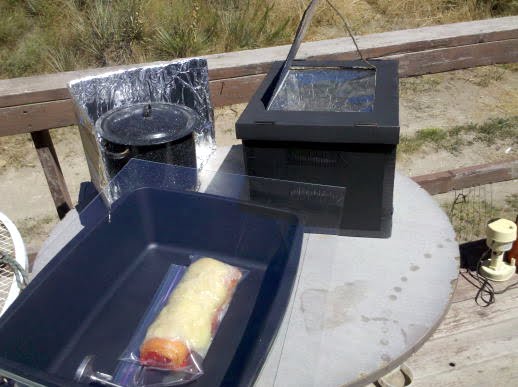
It was a lovely hot and dry day with little wind. Perfect for solar dyeing. We got started at a nice leisurely pace that seemed appropriate for the sunny Saturday. After setting everything out to cook, we ate and drank iced tea.

Instead of a long wordy blog, I'll let the photo tell the story with limited dialog. If you have questions, please drop me a line.


Of the three solar ovens, the kitty litter one worked best for the roving. When the Plexiglas was moved to the paper box, that one skyrocketed in temperature. If you aren't sure if the dye all took, just leave it overnight and rinse in the morning...if you can wait that long.

Wednesday, July 21, 2010

Mobius Cast On

Holy Cow!! I've got it!! How I love YouTube.

After being shown this technique and told how easy it is so many times and not getting it, I gave up. I found this video clip about how to do the Mobius Cast On and watched it over and over again. I even got out my needles and practiced it with the video playing. I am successful at this funky cast on now.
Cat Bordhi takes you through 9:52. "This tutorial will take you through the Moebius Cast-On (MCO) and first round of Moebius knitting, as taught in [her] two books on the subject: A TREASURY OF MAGICAL KNITTING and A SECOND TREASURY OF MAGICAL KNITTING."

Wednesday, July 7, 2010

Space Dyed Kool-aid and Solar Oven - Denise

Finally a beautiful day to try out the solar oven!! I grabbed another 4 oz (113 g) of Shetland/Mohair roving.

I'll try to outline this in the steps I took so it is easier to follow.
  1. I soaked the roving in soapy water for about 1/2 hour while I got everything ready.
  2. I picked out the colors to play with for the day: Pink Lemonade (pink), Blastin' Berry (red), and Grape (purple). I put down a damp paper towel and filled 3/4 cup of water and 1/4 cup of vinegar with each envelope of dye. The vinegar may not be necessary; some directions call for it, some don't.
  3. I laid out newspaper and plastic wrap on the table and then squeezed out the water from the roving and laid it out in a long "S" pattern.
  4. I dabbed on the pink first followed by the red, then purple in a palindrome pattern: pink end, red middle, and purple end (red, pink, red, purple, red, pink).
  5. I folded in the ends and wrapped it up like a jelly roll.
  6. I slipped it in a Ziploc bag.
  7. Out it went into my "preheated" solar oven at 11:00 AM. Temperatures reached around 160 degrees.
  8. At 3:10 PM, I pulled it out and let it sit to cool. It was hot! By almost 4:00 PM, I got antsy and filled the sink with warm water and set the whole thing in to slowly cool down.
  9. After about 15 minutes, it was cool enough for me. I filled the sink with warm, soapy water. The soapy water helps the wool slide off the plastic and rinses any remaining dye off the wool. I opened the Ziploc and hoped for the best. The good news is there was no bleeding from either me or the wool. Everything was absorbed!
  10. I did a final rinse with hair conditioner.
  11. I squeezed with towels and set it outside in the shade to dry.
  12. Check out the colors. I think Cosmos and Iris Garden.
A bit of fine tuning and I'll have the perfect oven. I think a second black kitty litter pan on the outside filled with wool as an insulator will keep even more heat in. Maybe a bit of foil. By then I should see temperatures reaching 250 degrees.

Monday, July 5, 2010

Space Dyed with Kool-Aid (Denise)

I planned on using my solar oven, but the storm clouds rolled in. I went with Plan B instead - the microwave oven.

I know some of you will be horribly shocked that I dyed with the same nuker I cook, but it is food grade dyes. The things in Kool-aid (KA) are less than in chicken nuggets or hot dogs.

Here my daughter is helping me paint the 4 oz. Shetland/mohair roving I bought from Jan Johnson some time ago.

I mixed the KA in 3/4 cup hot water and 1/4 cup vinegar. I soaked the wool for about 40 minutes beforehand in a slightly soapy water. I put down newspaper and plastic wrap and then laid out the roving. We chose what went first and painted. All the dye was used up.

I folded over the ends and rolled up the roving. I placed everything in a Ziploc bag to control the mess. Alternating 2 minutes nuked and 2 minutes rest, it cooked for about 6 minutes. I slowly cooled it down (in the bag). I rinsed and this is what it looked like. Not bad? It smells good too.

I've spun it up and it is destined to become some boucle yarn.

Tuesday, June 29, 2010

Dyeing Adventure (Denise)

The date's been set for July 24th for our painted yarn and roving adventure.

We'll start around 10'ish and use this lovely, yet primitive, solar oven to set the dye.

The oven works pretty well. In a test run in the evening, the temperature rose from 80 to 136 in 20 minutes. It topped out at 136. I'll spray paint the top black to help. I'll make a test run this week.

People need to bring around 4 oz of their favorite protein yarn or roving for painting. We'll use Kool-Aid or similar drink-ade for dyeing. Brand will not matter. Pick up 4 to 6 packages of 2-4 harmonious colors.

I asked my scientist husband and kids to do so...I'll live with their choices. Let's just say it's interesting. It'll work. I know who chose what colors.

We'll have plastic wrap, sponge brushes, cups, and vinegar.

Friday, June 18, 2010

Toe-Up Socks...The Basics (Denise)

YouTube Helpful Hints
These are some of the same techniques use. My wrapping and turning is a bit different, but the sock turns out the same in the end. Your foot won't really care in the long run. If you like the feel of Cat’s methods, use them.

Cat Bordhi demonstrates Judy Becker's Magic Cast-On: 9:41
I think this is the best provisional cast-on on the planet. It was invented by the ingenious Judy Becker of Portland, Oregon, and first released to the world by Knitty.com.

Cat Bordhi - Part 1: Knitting on 2 circular needle: 6:00
Learn the tricks of casting on to 2 circular needles, joining, and knitting around. You'll learn about the "udder needle," napping and resting, that it doesn't matter whether the inside or outside.
Cat Bordhi - Part 2 of Knitting on Two Circular Needles: 8:22

Cat Bordhi - Part 1: wrapping & turning, concealing: 9:57
Learn the tricks of wrapping and turning while working a heel turn, and then concealing the wraps in a way that means they are truly and forever concealed!
Cat Bordhi - Part 2: wrapping & turning, concealing:2:39

Thursday, June 10, 2010

MAWS Conference at Billings (Denise)

The MAWS "Under the Rims" Conference was fantastic, intense, light-hearted, inspiring, need I go on. I met people that are a delight. I learned so much from talking with everyone. I also spent too much money at the vendors. Being my first MAWS or any kind of fiber conference...wow!

I'd been to teacher conferences before (being a former teacher). As I sat at our banquet dinner I looked around the packed room. Teachers (like many professions) have a "look." Fiber artists don't have that look. I mentioned it to one of my table mates. She smiled and merely said, "No, we don't." She was absolutely right. We come from every walk of life, every age, and sex.

I taught two classes: "Toe-Up Socks" and "Judging Your Own Handspun." I can honestly say my students were the best of the conference. They kept me on my toes.

When my sock class "got it" the cries of realization were pure joy. They had Magic Cast-On and a turned heel to learn in 4 hours. I gave them some websites to visit afterward. Who really remembers everything from a class?

My judging class We discussed how to identify and fix the problems in our own handspun. They were a bit harsh on my handspun, but honesty is the best policy. They identified the problems immediately. We discussed elements judges look for when evaluating pieces for ribbons. We even discussed biases. I reminded them that art evaluators are not necessarily master painters. I, while being a fiber art judge, am always seeking to better myself, I'm not perfect.

Tuesday, June 1, 2010

Approximations for Plain Yarns (Denise)

I've got a helpful tool to help spinner guesstimate several things.
We can guesstimate how much fiber to buy.
We can guesstimate what size our yarn is after it is spun.
We can guesstimate what needle size is best for a knitted or crocheted project.
We can guesstimate how much yardage we may have.

Sunday, May 23, 2010

Strut Your Mutt Fundraiser (Denise)

This fundraiser forStrut Your Mutt the Great Falls Animal Foundation went well, despite the rain. They raised over $8,800 towards a new animal shelter and the free spay and neuter clinic "Spay of the Falls." (Thanks to the SYM people for helping me set up my tent.)

Thanks to Susan, her husband Odin, Lisa, and Dawn, and Marilyn and her husband David to coming to the event to spin, and lend moral support on the cold, wet day. We had fun, ate well (quiche, oops egg pie, tomatoes and fresh bread), answered questions, and laughed.

I have one Tribune Photo (more event photos here) of me spinning Bouvier des Flandres and Shetland sheep blend. Lisa supplied the fiber. She flicked and carded. I spun. Susan spun up her sea green tencil/mohair blend.

Flicking helps clean out any vegetable matter and dirt. Carding helps organized the fibers so it is easier and faster to spin into a smooth yarn.

Friday, May 21, 2010

Shearing Day on Sunday (Lisa)

The shearer plans to come out on Sunday morning to shear my sheep and the goat. Then, perhaps we will be going down the road to shear my neighbor's Columbia sheep. Plans are still up in the air. I hope to have a few pictures to post afterwards, and maybe a few select fleeces to post for sale.

Thursday, May 20, 2010

Handy Tool (Denise)


Here's a handy chart for converting simple fractions and decimals. I got tired trying to work the calculator and remember what fractions were what.

Whether knitting, crocheting, weaving, dyeing, woodworking, or anything else, this chart lays it all out for you.

Once there, you'll notice the patterns of repetition. It won't take a rocket scientist to realize the "Oh yeah, I knew that." But then again, Einstein never bothered to memorize his own home phone number because he knew where to look it up. Plus, he never called himself.

Tuesday, May 18, 2010

Getting My Money's Worth (Denise)

I am completely baffled. I wanted a plum color. I weighed my wool and yarn. I calculated twice to make sure I got the right numbers. I measured the dyestuff. I made the dyebath. It looked like the right color in the pot.

From the same dyebath I got:
1st batch: mallard blue green - pretty but not what I had in mind. It looks like the magenta didn't strike.


2nd batch: periwinkle - The dye wasn't used up, so I figured I could dye up anything. The leftover white bats were closer to the plum.

3rd batch: God knows. I'm leaving it to completely cool down, maybe overnight. It looks more magenta than plum. But now I'm curious, how will this turn out.

As you can see, below, the pale plum color is the one I wanted. My husband has a hard time with all these colors from one dye vat.

I'm certainly getting my money's worth. I wonder why the magenta didn't strike? Any ideas?

Does the magenta strike in the declining temperature as it sits in the cool down?

Sunday, May 16, 2010

Pickled Beet Dyeing (Denise)


This was my first foray into natural dyeing. While it worked well, just not quite what I had in mind. I had imagined a deeper color. I realize that if I wanted that, I should have used fresh beets rather than canned pickled beets. There just weren't enough beet pieces to make the colors I wanted.

Next time, I'm buying lots of fresh and chopping them up.

There's about 3-5/8 oz of superwash. I didn't use a premaordant. I did use vinegar in the beets to help set the color.
My steps:
  1. Open 2 cans of of pickled beets and dump into bucket. Simmer them for about 45 minutes. I probably didn't need to, but it gave the kids and me something to do.
  2. I added the pre-soaking roving and heated it all to simmering.
  3. I turned off the stove and left it to cool down. Since I don't like the smell, when it got cool enough, I moved it out to the porch.
  4. This morning, I drained, washed the roving. I set it out to dry.
  5. I decided I liked the color.

Thursday, May 6, 2010

More new projects (Lisa)


3 recently knitted caps. The first 2 are Merino X handspun, dyed with Cushing's dye (bright purple). A rolled brim with zigzag eyelet pattern and tassel (can't be seen in this picture), a 2X2 rib knit (same yarn and dye), and a felted cap in natural Shetland and Columbia X (onion dye) from the FiberTrends pattern "Bright Chapeau".
I'll be posting some items for sale at www.fiberfrontier.homestead.com very soon.